
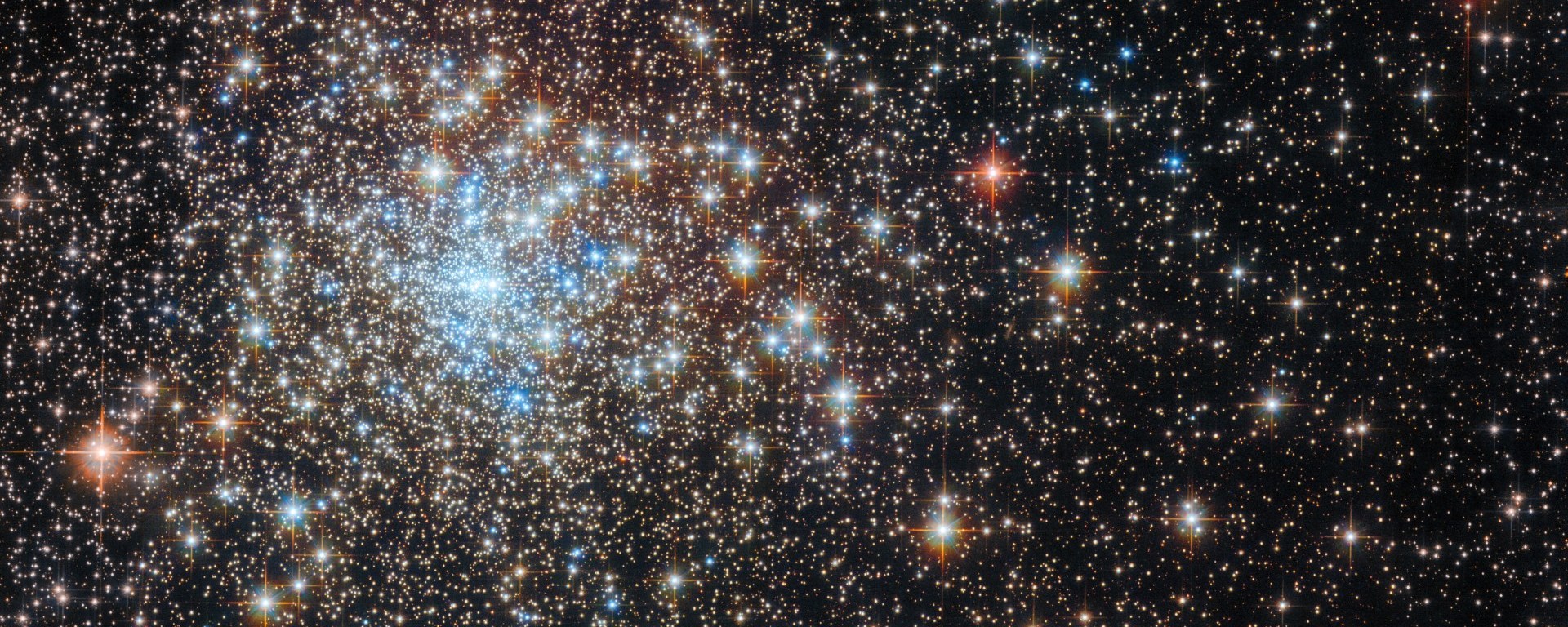
On March 29, 2024, the National Aeronautics and Space Administration (NASA) revealed that the Hubble Space Telescope has found not just one star, but 120 light-years worth of them. How the telescope captured the stars 160,000 light years away is not the usual method of zooming in.
In one of the Milky Way’s satellite galaxies 162,000 light-years away, the star field the Hubble Telescope found was in a Large Magellanic Cloud. The globular cluster is about 120 light-years across and still fits in the frame of the telescope. In contrast, other galaxies that are double, maybe triple, the size of the star cluster fill the frame. While this picture was taken from farther away, it was not zoomed in.
Telescopes used for space exploration have a fixed field of view. The Hubble, a Cassegrain reflector, the field of view used to pick up the visible lights in the photo was the Wide Field Camera 3, a twelfth of the size of the Earth’s view of the Moon. The Hubble is a type of telescope known as a Cassegrain reflector, which has two mirrors. The first reflects the light that hits it to the second which then sends the light back to the first mirror through a small hole which then transfers to the cameras for the final focus and production. The mirrors on the telescope have been polished and are about 2 meters in diameter, which allows enough light to be let in to capture objects 10 billion times fainter the human eye can see.
This field of stars is not the first, or last, photo the Hubble telescope has taken. As the Hubble has been in the sky since 1990, it has helped the scientists at NASA explore space and discover new stars and galaxies.
 The Snapper