
The phrase “one step forward, two steps back” is probably the best metaphor for the modern automobile industry, especially in the United States. While massive advancements have been made in electric vehicle technology, self-driving, and build quality, massive downgrades have come with them. Many modern vehicles now lack shifters, and instead use buttons. Some are worth tens of thousands of dollars, yet basic quality-of-life features are missing. And yet, it seems like the continuous backward progression of the American automobile industry is only continuing to accelerate with the disastrous release of the Tesla Cybertruck, which has spawned entire online communities, like r/cyberstuck, entirely dedicated to hating on both the vehicle and the Tesla corporation as a whole. While the American auto industry continues to struggle and experience major quality control issues, Chinese automobile manufacturers have become increasingly popular, so the President-Elect of the US has promised to place huge tariffs on them.
But, how did we get here? How did America, which used to be world-renowned for its auto industry (and in some ways still is) go from the top of the chain to a quickly shrinking position near the bottom? Well, we can begin with the decline of the American manufacturing industry in the late 20th century. Major manufacturing centers, especially in the Great Lakes region of the US, are now ironically known as the “Rust Belt” because of how many abandoned industrial plants litter their landscapes. States like Michigan, Ohio, and Wisconsin experienced rapid deindustrialization during this period due to American manufacturing companies relocating to foreign nations, taking their economic output with them, but leaving their now-destitute laborers behind. The hardest hit industrial sector by far was Automobile manufacturing, which infamously turned cities like Detroit practically into wastelands, with the Great Lakes region only recently beginning to experience a level of rejuvenation.

The former Packard Automotive Plant in Detroit, MI during demolition on March 4th, 2024. (David Guralnick/The Detroit News)
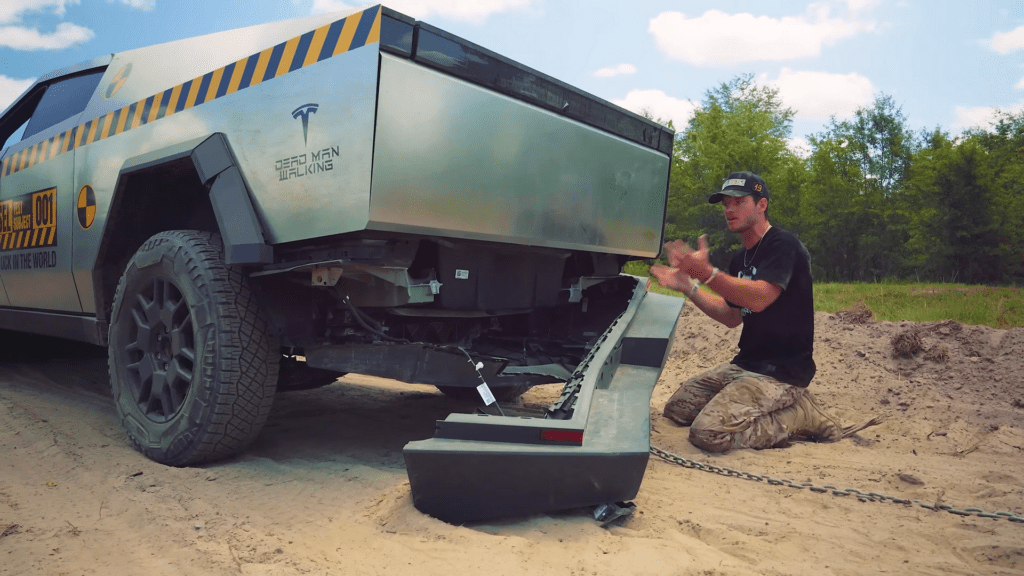
Now, since American automobile manufacturers moved their manufacturing to foreign nations (like China and Mexico), they could afford to pay these foreign workers far lower wages than what they paid American workers. They could also afford to start cutting corners, removing features, and downgrading the quality of their materials to save even more revenue. This led to a spiraling cycle of quality issues, from minor problems to whole vehicle lines like the revival of the Ford F series of diesel trucks being recalled due to a “potentially catastrophic cascade of damage” related to the engine’s high-pressure pump, according to Lou Ruggieri of Yahoo! Life. Other vehicles, like the Tesla Cybertruck, are known for dozens of issues, from the vehicle operating systems entirely bricking within minutes of it being given to the driver to the entire frame of the truck snapping in two during a test by YouTuber WhistlinDiesel where it was put up against a standard Ford F150.

The destroyed frame of a Tesla Cybertruck filmed during a WhistlinDiesel video testing its durability in comparison to a standard Ford F150. (WhistlinDiesel/Cody Detwiler)
Sources:
Scott, Robert E., et al. “Botched Policy Responses to Globalization Have Decimated Manufacturing Employment with Often Overlooked Costs for Black, Brown, and Other Workers of Color: Investing in Infrastructure and Rebalancing Trade Can Create Good Jobs for All.” Economic Policy Institute, 31 Jan. 2022, www.epi.org/publication/botched-policy-responses-to-globalization/.
Ruggieri, Lou. “Ford Recalls Nearly 300K Diesel Trucks because of COVID.” Yahoo Life, 7 Jan. 2025, www.yahoo.com/lifestyle/ford-recalls-nearly-300k-diesel-031908669.html.
Bochen, Han. “Donald Trump doubles down on China carmakers being unwelcome in US market” South China Morning Post, 10 Oct. 2024, www.scmp.com/news/china/politics/article/3281934/donald-trump-doubles-down-china-carmakers-being-unwelcome-us-market.
 The Snapper