
(Featured photo provided by the State of Alabama)
Recently, Alabama state lawmakers provided a new congressional map to be reviewed by a panel of federal judges. However, many questioned some of the changes these lawmakers made to the map and whether they were also going against a Supreme Court ruling.
It all started last year when a three-judge panel ruled that the congressional maps Alabama used for last year’s midterm elections had violated the federal Voting Rights Act by suppressing the voting power of Black voters, justified by the fact that there was only one black-majority district out of seven districts Alabama has. The panel then ordered that Alabama include at least two black-majority districts in its redrawn map or “something quite close to it.”
However, Alabama challenged this ruling and brought it to the Supreme Court of the United States (SCOTUS), where a majority of the justices agreed with the panel’s ruling in June. With no other choice, Alabama conceded and began the redrawing process.
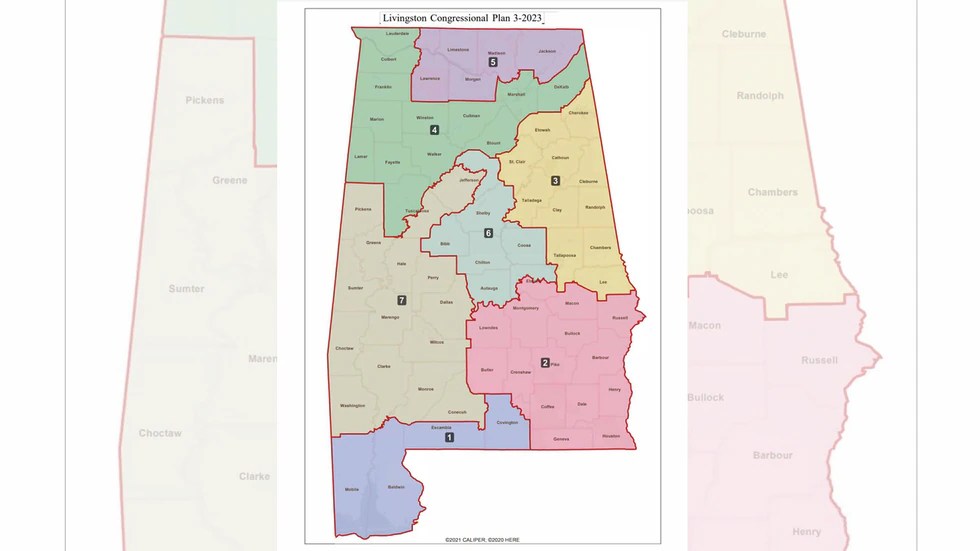
Come August 2023, the new congressional map was shown in court to the very same panel of judges on Monday, the 15th. On the newly proposed map, there is still one black-majority district, with the only significant difference being the percentage of Black voters in the white-majority second congressional district increased from 30% to just shy of 40%. Alabama’s solicitor general, Edmund LaCour, commented that this plan was the closest they could get to two black-majority districts without infringing on traditional districting regulations. “The Legislature knows our state, our people, and our districts better than the federal courts or activist groups,” stated Republican Gov. Kay Ivey.

Alabama’s Congressional map from 2021 (left) and the newly proposed map (right). District 7 remains the only black-majority district, with District 2’s black population only increased by about 10% and still the minority. (Photo provided by Mike Cason)
Lawyers for the state have also accused opposers of the plan of propelling a “racial gerrymandering” agenda instead of traditional guidelines. “It’s unlawful to enforce proportionality over traditional redistricting principles,” explained LaCour.
However, to many, Alabamian lawmakers have yet again failed to give its black voters a fair chance of electing their chosen candidate. During the trial on Monday, lawyers for the plaintiffs (opposers of the plan) argued that the new plan still discriminates against black voters since the state legislature failed to comply with court orders. “Alabama has chosen instead to thumb its nose at this court and to thumb its nose at the nation’s highest court and to thumb its nose at its own Black citizens,” said plaintiff attorney Abha Khanna.
The hearing on Monday in a federal court in Birmingham drew a large number of spectators, so much so that an overflow room had to be utilized. Although the hearing finished on the same day, the judges have not yet indicated how quickly they will rule. “The law was really clear about what the issue is here. Did Alabama draw a new opportunity district as the court required them to do? The answer is they did not,” stated Deuel Ross, an attorney with the NAACP, after the hearing.
Sources:
https://apnews.com/article/alabama-redistricting-voting-rights-act-7e7d8ca2fac4063f91311bd363515304
https://www.npr.org/2023/08/14/1193420289/alabama-congressional-districts-redistricting-map
 The Snapper